

Halloween is one of those topics Christians can have some pretty strong opinions about.
Some families fully participate. Some don’t. And some find a middle ground somewhere in between.
I want to state from the beginning that my intent here is not to cause division. The Bible is very clear that unity among believers is important, and I’m also not here to tell you what you should or shouldn’t do.
What I would like to do is share what I’ve learned about the history of Halloween, what people in different walks of life have shared with me, and how we can approach tricky things like this with wisdom and discernment.
Sometimes we need to pause and ask ourselves, “Does this choice honor God?” How God leads each family may look different, and that’s okay.
And just to be clear, I don’t believe that a young child putting on a cute costume, going trick-or-treating, or attending a fall festival at church automatically means someone is sinning or compromising their faith. I participated in both of those myself as a young child.
I have friends and family members who have made different choices than our family has, and I don’t look down on them for it. This isn’t about me deciding who is right or wrong. It’s about taking the time to prayerfully consider what we are participating in and why, and then giving one another grace when our convictions aren’t the same.
A Little History
There’s more to the history of Halloween than costumes and candy. Some of the traditions we recognize today have roots that may surprise you.
If we go all the way back to the Iron Age, the Celtic people of Ireland held a festival called Samhain. It marked the end of summer and beginning of winter, and was celebrated on October 31st into November 1st (sometimes November 7th).
There is not much evidence about how exactly the Celts observed this festival, mostly folklore, but the Encyclopedia Britannica shares this:
“It was believed that on Samhain, during this seasonal transition, spirits came to the world of the living, and their presence was regarded with trepidation. In conjunction with All Souls’ Day and All Saints’ Day, Samhain had an influence on the modern holiday of Halloween, and it is also celebrated as an important holiday in modern Paganism.”
The Celts responded by building bonfires which they believed would ward off supernatural beings, such as fairies, witches, and goblins, or as part of a divination practice.
Samhain continued to be celebrated in various forms until around 609 AD. Pope Boniface IV, the bishop of Rome at the time, created All Saints’ Day, also known as All-Hallows Day. The purpose behind those celebrations was to honor the martyrs and saints who died because of their Christian beliefs. Pope Boniface IV originally set aside time before summer to officially celebrate it.
Pope Gregory III moved the celebration to November later in the 8th century.
Over time, All Saints’ Day or All-Hallows Day has continued to evolve into what is known as Halloween today.
However, Halloween is still celebrated by Wiccans, which is a network of witches practicing witchcraft. They believe October 31st is when the realms between the physical and spiritual are the thinnest, so they use this day (and those around it) to tap into the supernatural realm.
Halloween is also a time of year when gruesome public displays and troublesome behavior are deemed acceptable.
Understanding the history doesn’t necessarily answer the question of what every Christian family should do for Halloween. But I do think it’s worth knowing where some of these traditions came from before deciding how we feel about participating in them.
What Does the Bible Say?
The Bible doesn’t specifically mention Halloween, but it does have quite a bit to say about darkness, evil, discernment, and how we’re called to live as followers of Christ.
The Old Testament offers several warnings, such as:
Leviticus 18:3-5 The LORD directed the Israelites to abstain from following the practices of those in the land of Canaan, to be careful to follow His decrees, that He is the Lord your God.
Leviticus 19:31 commands Israelites to stay away from mediums or spiritists.
Deuteronomy 12:29-32 and Deuteronomy 18:9-12 tells the Israelites to not even fall into the trap of asking the other nations about their gods, to not imitate their gods, and that worshipping their gods is something He hates.
The New Testament offers several reminders to us as well.
1 Corinthians 10:20-22 Paul reminds us not to participate with sacrifices of pagans for we can’t follow them and the Lord at the same time.
1 Corinthians 10:31-32 exhorts us to do all that we do to the glory of God and to be mindful of how our choices might affect others.
Ephesians 5 gives us several examples of how we can live lives that honor God, including living as children of the light, not darkness and to be careful to choose wisely because the days are evil.
Peter reminds us to stay sober-minded against evil forces roaming around (1 Peter 5:8). John exclaims that we can’t love both the world and the Father (1 John 2:15).
We are reminded to resist the devil and flee from him in James 4:7. We should not live in fear, but we also shouldn’t tempt or taunt other forces knowing we have a way out.
We’re also told we’ll be judged by what we have done, both good and bad (2 Corinthians 5:10).
Spiritual Discernment
It might be tempting to think that because the Bible doesn’t specifically reference Halloween (or xyz), there’s a free pass to interpret things however we want.
I think this is where we need to be careful.
Thankfully, as believers, we have the Holy Spirit to guide us. Spending time in God’s Word and making room to hear Him is vital to a strong faith.
If we frequently let worldly voices speak loudest, we run the risk of not hearing the Holy Spirit’s prompting clearly.
There are things Scripture is very clear about and things left to interpretation. Halloween is one of those areas where families may come to different convictions.
Equally important is making sure we don’t weaponize God’s Word against someone who reaches a different conclusion than we do.
So What Do We Do With It?
Honestly, I’d encourage you to pray about it.
Like, really pray about it.
Spend some time with it. Do your own history research. Read the Scriptures. Talk about it with your spouse if you’re married. Ask God for wisdom and be willing to follow where He leads.
Whatever you decide, I’d also encourage you to talk it through with the kiddos (as appropriate). This could be a great opportunity to model how we approach God with things we’re uncertain of, let Him lead us, and then follow through in obedience.
The point isn’t that we all have to come to the exact same conclusion. The point is that we’re willing to stop and ask whether the choices we’re making are honoring God, and then give each other grace when our convictions differ.
I saw these questions posed recently and thought they offered a good starting point:
“Before you decide how to engage with Halloween, consider these questions:
- Will I be exposing myself or my children to elements of fear or demonic influence?
- Am I encouraging comfort with the supernatural in a way that Scripture condemns?
- Will we be participating in activities that the Bible explicitly warns against?”
A filter I like to use for what our family hears, sees, keeps around, and where we go is from Philippians 4:8, “Finally, brothers and sisters, whatever is true, whatever is noble, whatever is right, whatever is pure, whatever is lovely, whatever is admirable—if anything is excellent or praiseworthy—think about such things.”
What Do We Not Do
As stated before, this is one of those things where families will differ. If they are sincerely following what they believe God is leading them to do, then we need to extend grace when their conviction differs from ours.
It is not our place to tell another family what they should or shouldn’t do when Scripture leaves room for personal conviction.
Displaying grace and love will go much further than sharing a dissertation on why your point of view is correct and they’re in the wrong.
If someone asks your perspective, go ahead and share, as long as you can do it in a loving fashion that invites room for positive, open discussion.
Having a difference of opinion over matters left open to interpretation should never lead to division, hatred, or looking down upon someone.
Mama Bear Apologetics Resource
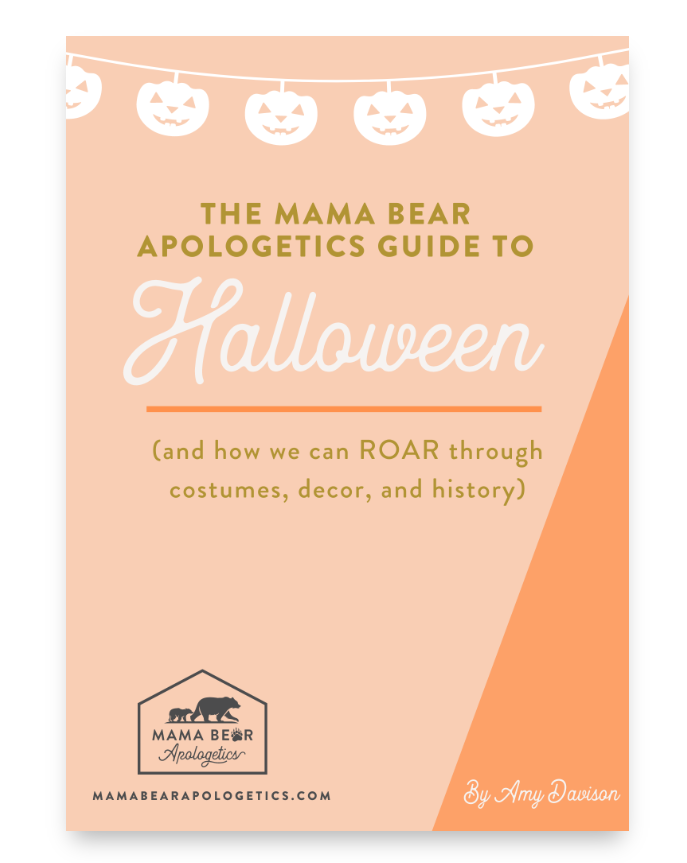
If you are looking for something that goes into more detail on this topic, try The Mama Bear Apologetics Guide to Halloween: (and how we can ROAR through costumes, decor, and history). It’s been a helpful resource as my kiddos have aged and asked different questions.
You can enter your email on their site here to get the free PDF.
Side Notes
Sensitive Perspective
Another aspect that might be helpful to consider is how sensitive your kiddos are.
As a visual person, I tend to be more sensitive and have strong reactions to both sights and sounds. My kiddos also happen to be more sensitive, which I always wondered about until I ran across a ‘new to me’ viewpoint mentioned on a parenting podcast.
The wife was sharing that her children were usually scared when other children around them weren’t. As she thought about it, she realized that part of preserving her child’s heart meant not allowing them to become desensitized at an early age. She explained how images can have a huge impact on young children, and as they see things over and over, they become accustomed to it.
Her perspective was like an “aha” moment in this regard.
Former Wiccan Perspective
One of the conversations I mentioned in the intro was with an extended family member. Many years ago, I was speaking with her about this holiday, trying to sort out how our own family would handle it. She graciously talked about one of her extended family members’ experience being a former Wiccan.
She shared what this former Wiccan had told her, which was that if Christians really understood what was happening around Halloween they wouldn’t touch it with a ten-foot pole.
That always stuck with me. I think it resonated because I’d lived out my own time in the wilderness away from God, experiencing and seeing things I never would have imagined existed in my younger years.
Spiritual Warfare Perspective
We have dealt with some unsettling spiritual warfare in our home. It has been extremely eye opening to contend with evil forces, coming from seemingly innocuous things like children’s movies, books, and toys, and visiting other places.
I have also had conversations with a few people involved in deliverance ministries (not to be confused with exorcisms). Listening to what they’re able to share gave me additional perspective on how deceiving the devil really can be. I’ve lived life doing the dance with him before. Praise God I’ve been delivered from many bondages myself.
As a result, I’m pretty vigilant, to the point where people might say we “live in a bubble.” And I’m slowly learning to be okay with that.
As a Christ follower, I don’t believe God has directed me to expend effort on fitting in with the masses, bending to appease those around me, or acquiescing because my intentions or heart are different from others so it’s okay.
As a mother, God hasn’t called me to say yes to my kids because all the other kids do it, or raise my children to know all the latest social trends, fashions, entertainment, etc…
Quite the opposite actually. We are told not to conform to the patterns of this world (Romans 12:2) and to expect hardship (John 16:33). We’re also instructed to love the LORD our God with all our heart, soul, and strength, to keep His commands upon our heart, and to teach our children the same (Deuteronomy 6:4-8).
Is it hard? Of course. But Satan will use anything and everything to distract us and lead us astray. Spiritual warfare is real, and we must always be ready to fight with the full armor of God (Ephesians 6:10-18).
One Last Thought
If you take nothing else away from this, I hope it’s simply this: take it to God.
Pray about it. Open His Word. Talk it through with your spouse and your children. Ask Him for wisdom, and then be willing to follow where He leads, even if that choice looks different from what another Christian family chooses.
And if you land somewhere different than I do, that’s okay.
We don’t have to agree on every gray area to love one another, encourage one another, and walk faithfully with the Lord.
At the end of the day, my goal with this post isn’t to tell you what to do about Halloween. My hope is that it encourages you to slow down, think it through, seek God, and make your decision with confidence in Him rather than pressure from the world, other Christians, or even me.
Because ultimately, it’s not about Halloween. It’s about learning to invite God into the choices we make every day.
Stay Connected!
Encouragement for Faith & Everyday Life
Life can feel full with faith, health, home, and all the small things in between. The newsletter is a simple way to stay connected through new blog posts, encouragement, occasional shop news, and free tools that support intentional, everyday living.
A glimpse of the free tools